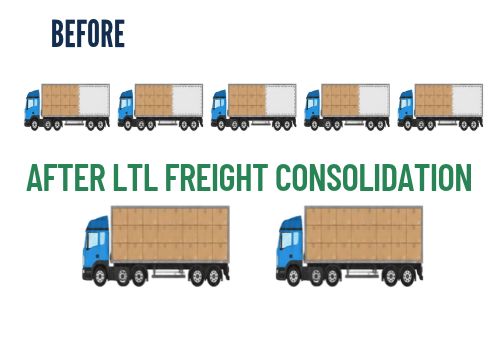
North American shippers have seen fuel prices soar this year. When you’re already dealing with the high cost of diesel, the problem is compounded if your trucks leave half empty. Many shippers and carriers lose money when moving small, separate less than truckload shipments. LTL consolidation is a strategy that can help you keep your margins higher.
In our blog we’ll outline what LTL consolidation is, why LTL consolidation matters to your business and provide a blueprint of six steps so you can manage less than truckload consolidation well.
What Is LTL Freight Consolidation?
LTL freight refers to shipments that are too small to fill a whole trailer. These shipments can be anywhere between one and six pallets.
LTL freight consolidation is where you combine smaller shipments that are heading in the same direction to create a full truckload. This can lower costs and raise profits by using more of the truck’s space and paying less per pound or kilogram.
Think of LTL consolidation like carpooling, instead of everyone driving alone. In LTL consolidation, multiple smaller shipments can get to their destination efficiently without taking up an entire trailer.
There are two common forms of LTL consolidation. Shipper side consolidation is where you combine your own shipments. Carrier side consolidation combines freight from many customers.
Why LTL Consolidation Boosts Profitability
Combining two or more smaller shipments helps improve profitability in multiple ways. Studies have shown that almost half of all trucking trips are less than truckload, which means there are gains that can be made through consolidation. Here are the other reasons LTL consolidation can improve your bottom line.
Lower costs per unit shipped: Fewer trucks and fewer handoffs mean lower costs overall.
- Fewer accessorial fees: Less handling at terminals means fewer extra charges.
- Less damage: freight is loaded and unloaded fewer times.
- Better asset use: you log more revenue for every mile.
- Sustainability: fewer trips lead to lower fuel use and emissions, which is something your customers increasingly care about.
6 Best Practices for LTL Consolidation
The benefits of LTL consolidation can quickly improve your overall trailer utilization. Here is a six step freight consolidation strategy that will help you convert your underutilized trailer space into better margins overall.
Centralize Your Shipment Data
If your business data lives in spreadsheets and email, it’s harder to combine what you can’t see. Your first step is to pull orders, destinations, weights, and ship dates into a single system, which makes all your shipments transparent.
Group Shipments by Lane, Timing, and Destination
Using a single source of data will allow you to identify shipments that are going to the same region within a similar window. You can choose how to approach your consolidation depending on the shipments you handle.
Zone skipping consolidates individual e-commerce parcels destined for the same region and allows shipments to bypass multiple sorting facilities and offloaded at the local delivery destination, where the pallets are then routed for final mile delivery. This strategy reduces expensive per parcel shipping rates and allows more efficient deliveries for e-commerce and direct to consumer parcels.
Pool distribution allows you to pool multiple pallets that are being delivered within the same geographic region. Typically, once LTL shipments are consolidated, they are sent to a distribution center, offloaded, and delivered locally on multi stop routes. Pooling allows transport companies to reduce costs and more efficiently handle multiple small shipments from B2B retailers or manage distribution center replenishment.
Use Load Optimization to Fill Every Trailer
Upfront planning by your dispatch improves load optimization. Ensuring your trailers are rolling with the maximum capacity means you’ll need clear, accurate data to help you track weight and cube space and plan for maximum stackability.
You should be able to accurately forecast and manage freight class data, work with standard pallet sizes, and plan the load sequence by delivery stop. Modern transportation management software helps you plan and helps you improve your overall margins.
Set Consolidation Windows with Customers
Speak with your customers before you sign the contract. Clearly communicate the benefits of an agreed shipping day. For example: Tuesdays and Thursdays could be your Midwest delivery days. Most customers will be willing to accept a small delay when they learn there are big savings attached.
Choose the Right Carrier Partners
Effective shipping relies on good partnership agreements so your shipments can go the final mile. You want carriers and Third Party Logistics partners with strong networks in your key lanes.
Choosing the best carrier partners means doing your research. Compare the cost differences for multi-stop truckload, volume less than truckload, and standard LTL, so there are no surprises when you deploy different shipment strategies.
Track the Right KPIs
LTL Optimization is an ongoing process, not a one-time fix. Reporting can help you improve on your processes. Here are the ideal metrics to track: cost per pound or per unit, trailer utilization rate, on-time delivery, and damage claims.
Review your results monthly and adjust when needed.
Common LTL Freight Consolidation Mistakes to Avoid
As you improve your LTL freight consolidation practices here are some mistakes that can cost you progress.
Mistake 1: Holding freight too long to optimize a single truckload.
Result: Missing your delivery promise.
Mistake 2: Failing to track freight class and density.
Result: Unexpected reclass fees.
Mistake 3: Reliance on manual planning.
Result: Inability to keep up with shipment volumes.
Mistake 4: Chasing the lowest rate.
Result: Missing the best total cost.
How Technology Makes Consolidation Easier
Manual consolidation of freight can be time consuming and has the potential for significant mistakes that can cost you margin and reputation. Using a transportation management system will help you identify consolidation opportunities, offer load plans, and help you compare carrier rates.
Tools like Degama’s DTMS help your team view every shipment in a single system and help you plan fuller loads in shorter time.
Conclusion
LTL consolidation helps trucking and logistics companies transform small shipments into fewer, more profitable load. The key to successful management of your LTL shipments is following best practices. Centralize shipment data so you know what you’re managing; group shipments by destination to capitalize on volume for each region, maximize the freight in each trailer so your trucks are rolling with full or near full loads, get your customers to buy in on consolidation windows so they save money, select carrier partners with extensive local networks to keep your efficiency high, and track the right KPIs to ensure your strategies are working.
Technologies like TMS systems can help you manage your LTL shipping data more effectively. Read our guide to calculating the return of investing in a TMS system.

Recent Comments